
Ai survey
AI in recruitment: The value of the human in the loop
ACCA’s Global Talent Trends survey received over 11,000 responses from over 160 countries, and has highlighted concerns around AI in recruitment, with 69% of UK respondents having reservations about its use. Joe Pickard speaks to Jamie Lyon, global head of skills, sectors and technology at ACCA, to find out more.
Earlier this year, IRBA concluded a three-city roadshow to provide a platform for dialogue on inspection outcomes, challenges facing the profession, and various initiatives that aim to support improvements to audit quality in South Africa.
Speaking at the Johannesburg leg of the roadshow, Shabeer Khan, National Treasury’s accountant-general and the Minister of Finance’s representative on the IRBA board, said: “As a country, we have lived through painful chapters; chapters where state capture, corporate failures and financial misconduct eroded trust and public confidence in the systems meant to safeguard our democracy.
“Those failures remind us that audit quality is not just a professional matter; it is a national imperative. And make no mistake; trust is the currency on which economies run. And therefore, at its core, audit is about selling trust.”

Antonis Diolas
Head of Audit and Assurance with ACCA’s Policy & Insights teams, draws on extensive experience in auditing across different countries, and industries to lead on ACCA’s global work on audit and assurance. He previously served as technical advisor at the IAASB and IFAC SMP Advisory Group.

Joe Fitzsimons
Leads ACCA policy work across Europe, Eurasia, the Americas, Middle East and the UK. He was formerly a member of the policy team at the Institute of Directors, where he led across a range of policy areas, including education and skills, EDI, and SME support.
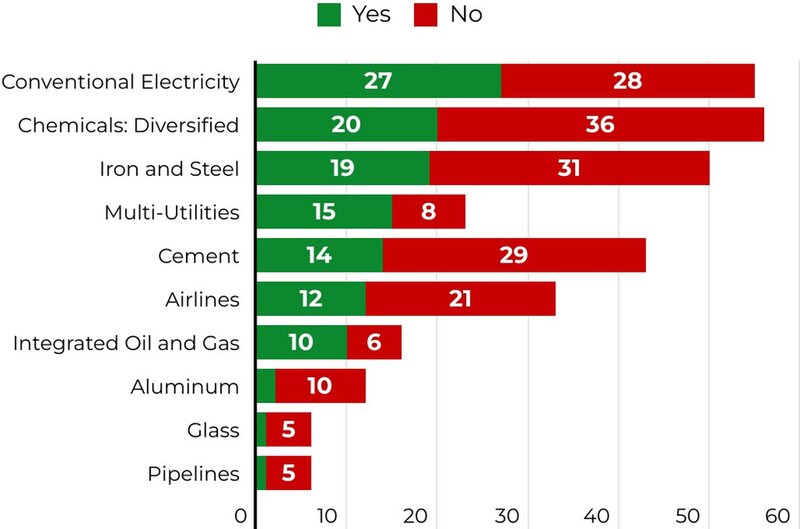
Engagement with carbon-related instruments are not concentrated in any subsectors.
Currently, there is no IFRS Accounting Standard or guidance dedicated to accounting for carbon-related instruments. Consequently, companies have had to develop their own accounting policies to account for these instruments as either assets, liabilities, income or expenses. As a result, several accounting treatments are observed across companies.
On the assets side, these instruments are most often accounted for as ‘intangible assets’, followed by ‘inventories’ and ‘financial assets’. Some companies presented these instruments as ‘other assets’. Further, these instruments are measured at cost or at fair value (or a combination of both approaches). Some companies do not disclose their measurement approach at all. On the liabilities side, some companies recognise provisions on a gross basis, while others do so on a net basis.
The size of these instruments, as a percentage of total assets or revenues, varies considerably among companies without being significant for all companies. This indicates that the instrument’s magnitude is not the sole determinant for recognition and disclosure in the financial statements. Nevertheless, there is room for improvement to provide information in the financial statements about these instruments’ nature, function, intended use, useful lives, amounts and accounting policies to help users understand their relevance and financial effects on the company.
Relatively few auditors’ reports discuss issues around carbon-related instruments. Those that do tend to discuss issues relating to the exercise of judgement or the use of assumptions, such as accounting for carbon-related instruments, measurement of these instruments, impairment tests for assets, and changes in accounting policy.

It’s about keeping employees interested in the firms they work for and retaining good talent so that they can continue to grow with, and add value to, the company. After investing in the skills to develop good people, we want to strengthen work environments that keep them.

The Accountant: How can accountancy firms best use AI in their recruitment processes?
Jamie Lyon: It depends. AI can be used at different stages from candidate sourcing, candidate shortlisting, candidate interviews and assessments to candidate offers and engagements.
The point is that wherever it is used, it is critical to have transparency and good governance over its use, otherwise there is a significant risk of reputational damage and potential recruits being turned off by the process.
The main thing with prospective employees is to make sure applicants do not feel their application is falling into a void with no communication of outcomes at each stage of the process.
The Accountant: What are the main risks of bias in using AI in the recruitment process and how can employers safeguard against this?
Jamie Lyon: The main risks that we see are:
- No feedback to applicants – this is perhaps the most frustrating outcome where applicants hear nothing. This is significantly damaging to the employer brand.
- Perceptions that there is no human in the loop and all the decisions are taken by the technology – the sense of anonymity and distance.
- Algorithmic bias – what data has the technology been trained on and are there any biases that have inadvertently been built in?
- Candidate data privacy, and obviously linked to this, GDPR regulation.
- Applicants gaming the system and overusing the technology as part of their applications, which creates a race to the bottom. This means there are significant risks that the most appropriate candidates for the role are being missed.
The Accountant: How widespread is the use of AI in recruitment at accountancy firms?
Jamie Lyon: It is well established at different parts of the process and its use will continue.
The Accountant: Is the use of AI in recruitment the same at different seniority levels? Is it being used more to fill junior positions? How can it be used to assist in senior level appointments?
Jamie Lyon: Our sense is that at more senior levels, the balance of human intervention in the end-to-end hiring process increases. At a senior level, its use has to be very carefully considered, particularly given the more personalised approach often required at these levels. It could, however, have benefits in areas such as
- Candidate sourcing: Scanning senior talent pools / understanding available talent in the marketplace to draw up initial targets / shortlists.
- Candidate shortlisting: Verifying the achievements documented based on publicly available business information, and using the AI to focus on assessing the outcomes actually achieved by candidates.
- Logistics: Using AI to assist with the end-to-end recruitment workflows such as scheduling coordination and personalised communication.
But the bottom line for all senior-level appointments is there should be appropriate human oversight and well-understood key human interventions and touchpoints.
The Accountant: What practical advice is ACCA offering to make sure AI use in recruitment is fair?
Jamie Lyon: ACCA offers four key pieces of practical advice to ensure AI use in recruitment remains fair, each of which aligns closely with current UK legislation and regulatory guidance:
Make sure you are abiding by the regulations. Because AI regulations are moving so quickly, employers must constantly monitor how existing UK laws apply to the new tools.
Under the Equality Act 2010, companies face direct legal liability if their recruitment algorithms produce biased outcomes or discriminate against protected characteristics. Furthermore, the UK GDPR and Data Protection Act 2018 strictly govern how candidate data is processed by automated tools, requiring a clear lawful basis for any data collection.Ensure that your processes are transparent and governed appropriately. This includes providing relevant training for anyone involved in the hiring process. Transparency is a core legal requirement under the UK GDPR, for example, and this mandates clear privacy notices for your candidates.
Give significant consideration to human checkpoints. You should introduce human interventions across the breadth of your end-to-end hiring process and at different levels of seniority.
This directly mirrors the official guidance from the Department for Science, Innovation and Technology. Its Responsible AI in Recruitment Guide emphasises that human oversight and accountability are vital to ensuring algorithmic fairness.Introduce audits and appropriate monitoring controls. Safeguarding AI use requires proactive risk management. Under the UK GDPR, employers must conduct a mandatory Data Protection Impact Assessment before deploying any automated decision-making systems.
Additionally, the Information Commissioner’s Office actively enforces rules around automated hiring and expects recruiters to regularly test their AI tools for bias and accuracy.
Auditors
Auditors should:
- check the coherence of information in the financial statements and the narrative part of an annual report, and
- lend their technical expertise to support the development of globally applicable guidance for consistent accounting treatment of carbon-related instruments, and to help ensure the resulting accounting and disclosure requirements are auditable.
See here for the full report.
Main video credit: KanawatTH / Shutterstock.com